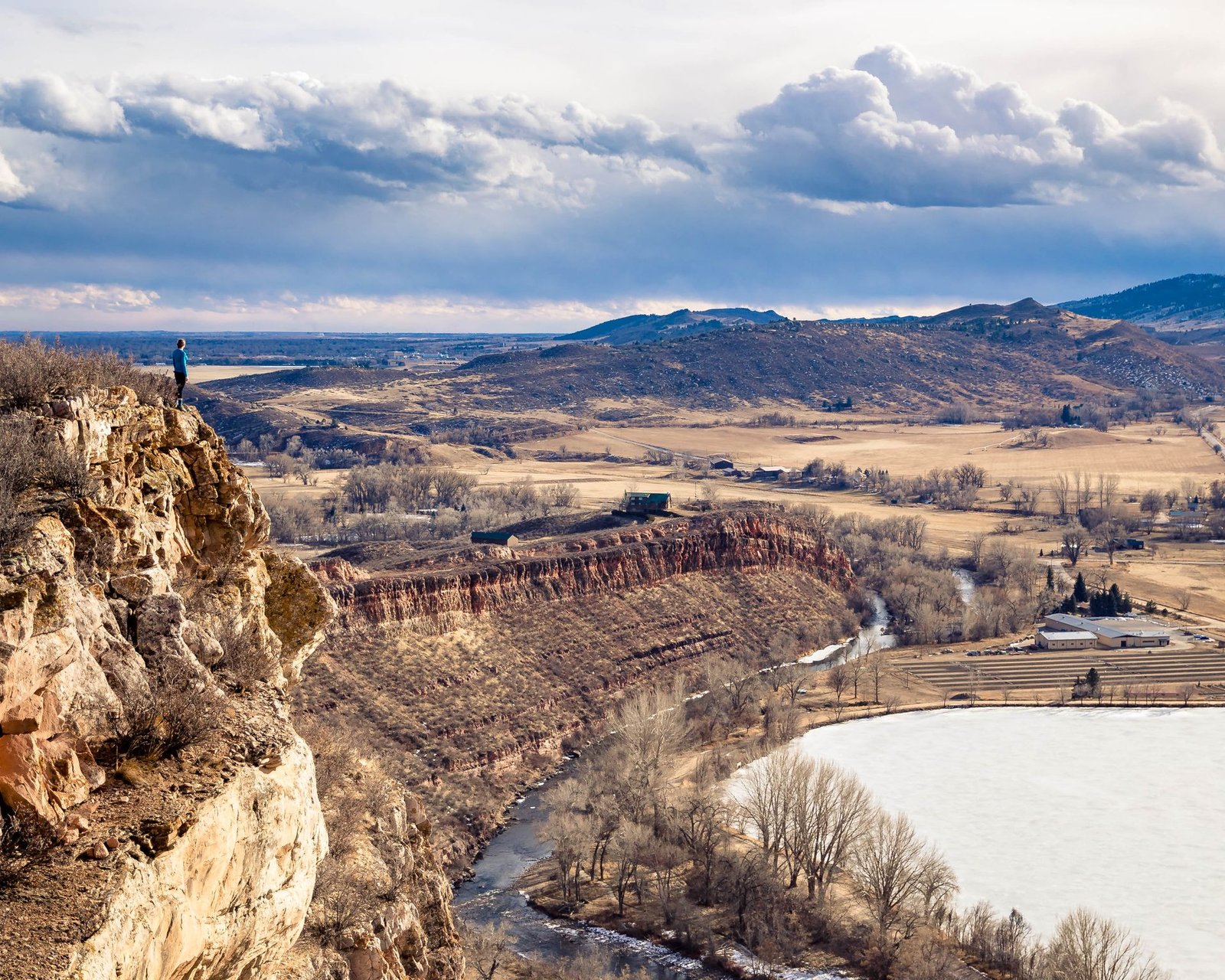
A site at the mouth of a canyon rarely offers a flat rectangle, and that is where we are most useful in Bellvue. The work here is drilled piers on sloping ground, rock and cobble excavation, retaining walls, access roads with real grades and the temporary measures that keep a narrow valley stable while a building goes up. We take on those conditions for owners who want a shop, utility building or small industrial facility in the Pleasant Valley area northwest of Fort Collins.
Bellvue is an unincorporated community of Pleasant Valley, a narrow valley on the south side of the Cache la Poudre River at the mouth of Rist Canyon, at 5,131 feet. The valley's southern portion is now inundated by Horsetooth Reservoir, a fact that tells a builder two things: land is scarce and the remaining ground is defined by water on one side and the foothills on the other.
Our approach is the same as for any difficult site: learn the ground first, give the owner a realistic budget for the site work, and build a structure that fits the land instead of forcing the land to fit a standard plan.
Excavation, Piers and Retaining Work
On a hillside, the foundation is the job. Cut-and-fill pads need compaction testing and drainage behind retaining walls, and where bedrock or cobble makes shallow footings impractical, drilled pier foundations transfer the load to competent material. We schedule and supervise these operations and coordinate the geotechnical engineer's inspections, since a pier depth change in the field is routine and needs a quick decision.
Excavation in this setting also means managing rock. We plan for ripping, hammering or blasting subcontractors where the geotechnical report warns of shallow rock, and we price the quantity as a unit rate so that the owner pays for what is found, not for a guess. Retaining walls are placed with drains and a clear path for water, which is the most common cause of failure in a hillside cut.
Access Roads and Small Utility Buildings
Getting to the building site is often the largest line in the budget. A road up a canyon side needs a safe grade, a width for delivery trucks and a surface that survives snowmelt and rain. Our heavy-haul access roads are built with a compacted base, a crowned cross-section, ditches and culverts sized for the runoff, and turnarounds large enough for the longest delivery.
The buildings are usually modest. Equipment housings, pump buildings, maintenance shops and small storage structures are the common needs, and we build them as steel or masonry structures with concrete foundations. Where power is needed in a remote location, an underground line can be installed as part of the site utilities package.
Why Site Costs Lead Here
Budgets in canyon-mouth terrain are weighted toward earthwork. The cost of cut and fill, rock handling, retaining walls, long utility runs and an engineered road can exceed the cost of the building on the pad. We therefore deliver a site budget first, before the building design is advanced, and give owners an honest picture of what the land will cost to prepare.
Utilities are another driver. Parcels at the edge of the developed area may lack municipal water, so fire protection may require a storage tank and pump, which the trade partner team for fire water and hydrant can design and install. Wastewater is typically an on-site system, subject to county approval.
Reservoir, River and Dam Safety
Horsetooth Reservoir holds 156,735 acre-feet behind four earthen dams, Horsetooth, Soldier Canyon, Dixon Canyon and Spring Canyon, completed in 1949 and seismically retrofitted from 2000 to 2004 as part of the Colorado-Big Thompson Project. It is a major piece of regional water infrastructure and its operator controls access and activity near it, so a site close to the shore or a dam is likely to have conditions on what can be built and when.
The river adds its own layer. The Cache la Poudre drops about 6,155 feet over its course from Rocky Mountain National Park to its mouth, and 76 miles of it were designated a National Wild and Scenic River on October 30, 1986. Anyone working near the river should ask early whether federal or state review applies to the parcel. We raise the question during feasibility instead of at permit submittal.
Hillside Safety and Fire Season
Slopes change how we protect workers. Excavations deeper than a few feet need sloping, benching or shoring, loose cobble on a cut face needs scaling or a barrier, and equipment working across a grade needs a defined path and a spotter. We write a site-specific plan before mobilizing and review it with every crew, because the first week on a hillside is when most mistakes happen.
Dry foothill vegetation brings a seasonal risk. Hot work such as welding and cutting needs fire watches and extinguishers, equipment is parked on cleared ground, and the single access road is kept open for emergency vehicles. We confirm the local fire authority's requirements for defensible space around new buildings as part of design, not as an afterthought.
Neighbors and Related Work
Bellvue shares its river with Laporte downstream, and many of the same floodplain and drainage questions apply. For another foothills-edge setting, with its own utility and access questions, see the CSU Foothills Campus.
Owners in the utilities and power field often need small control buildings, pad-mounted equipment and access roads in precisely this sort of terrain. The methods described above apply directly to those projects.
Let Us Walk the Parcel With You
Send the parcel and the building you have in mind. We will walk the site, review the geotechnical findings and return a site budget before design advances.
Common Questions
Can you build on a steep parcel at the mouth of Rist Canyon?
Often yes, if the geotechnical work supports it. We look at slope stability, rock depth and the access grade first, and then decide between a cut-and-fill pad, a stepped foundation or drilled piers. Some parcels are not worth developing, and we say so early.
How do we get water for fire protection without a municipal line?
Usually with a storage tank and a fire pump sized to the building's requirement, approved by the fire authority. We include the tank, pad, pump house and underground piping in the site budget.
What does it cost to build a road to a canyon site?
Cost depends on length, grade, soil and the number of culverts, so there is no single figure. We walk the route, estimate the earthwork and drainage, and price the road separately so you can see its share of the project.
Which agency reviews work near the reservoir?
The water project's operator controls activity near its facilities, and Larimer County reviews building and grading permits for unincorporated land. We contact both during feasibility and confirm the conditions that apply to the parcel.
Is winter construction practical in the foothills?
Yes, with planning. Snow and cold slow earthwork and concrete, and shaded canyon slopes stay frozen later. We schedule excavation and foundations for the milder months where we can and plan winter protection for the work that cannot wait.
Related
Related Services
Related Service Areas
Ready to talk about your project?
Request a Project ReviewOne project team for the whole sequence
Industrial Contractors of Fort Collins reviews the site, the loads, the schedule and the approvals before pricing, then schedules, coordinates and inspects the specialty trade partners from preconstruction through closeout.