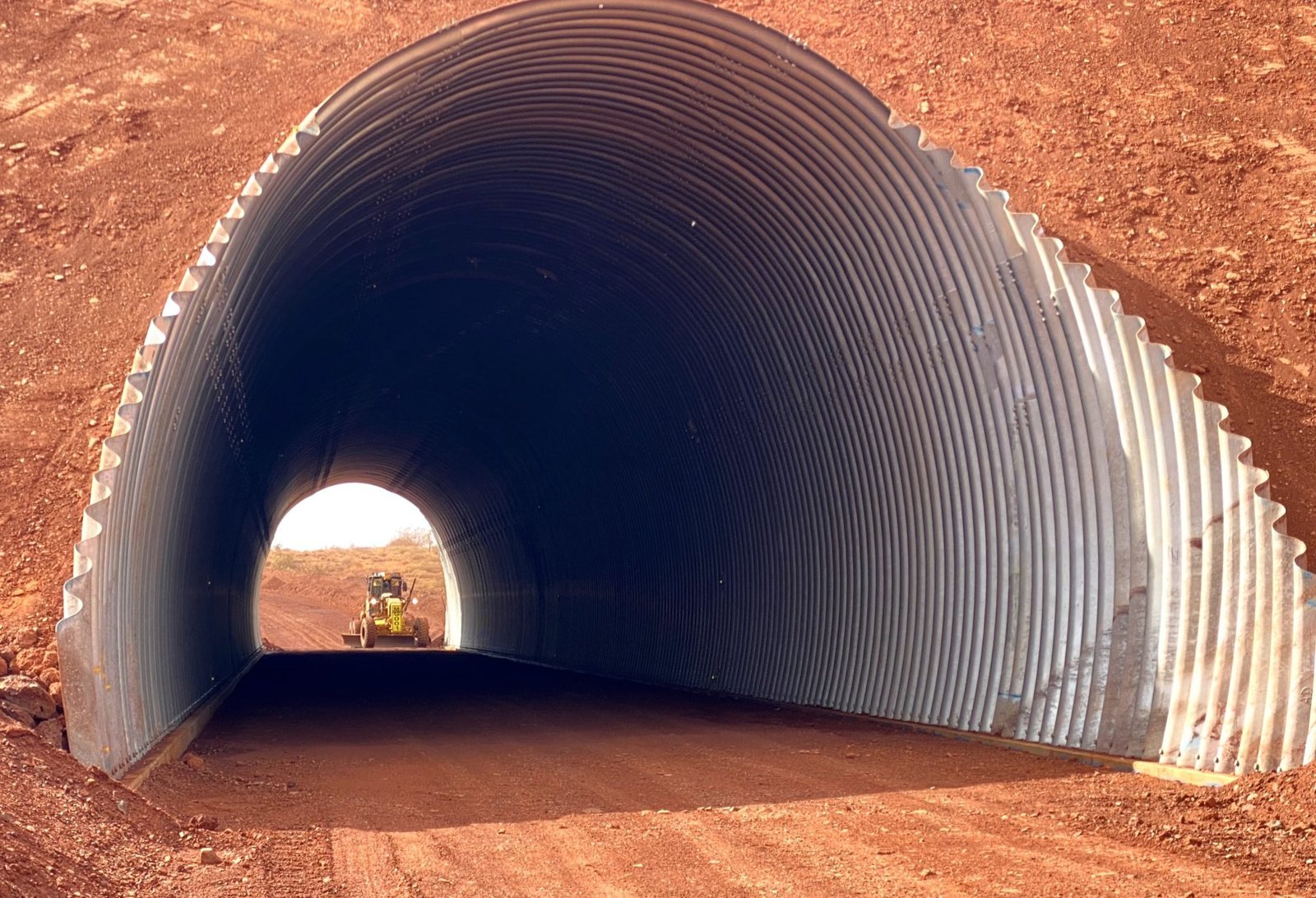
A county road built for hay wagons and a plant that takes in milk by the tanker load do not stay compatible for long. Industrial sites on the northern Front Range often sit at the end of a rural road, and the pavement that was fine for farm traffic starts to rut, pump and break when a few hundred loaded trucks a day use it. Heavy-haul access roads are our answer to that problem: purpose-designed approaches and internal drives that carry tractor-trailers, tankers, heavy-haul loads and construction equipment without constant repair.
Greeley shows the scale of what these roads serve. Leprino Foods built its cheese plant there as an over $250 million, 883,000 sq ft facility designed to use more than 7 million pounds of milk per day at full build-out, and the JBS beef plant is described as able to process roughly 6,000 cattle per day. Those operations depend on a steady inbound and outbound truck flow, and the quality of the road at the gate sets how reliably that flow moves.
We build the road as a structure, not a surface. That means a pavement section designed from the traffic count and the soils, drainage that keeps water out of the base, and geometry that lets a full-length trailer enter and leave without driving over a curb or blocking a public road. Where the road crosses a ditch or irrigation channel, we coordinate with the stormwater and drainage design and with the ditch owner.
Why Weld County roads wear out quickly
Much of the industrial land between Windsor, Greeley and Evans is served by arterials that were built for agricultural traffic. Windsor sits at 4,797 ft elevation with its main business district along State Highway 392 and a BNSF line north of Main Street, so industrial trucks in Windsor mix with commercial traffic and rail crossings near the town center. Moving trucks cleanly from a plant gate to a highway often means building a new connector rather than loading an old road.
Milliken is a useful reminder of how much the road network shapes industrial growth. A 2006 BizWest article placed the town about two miles east of I-25 and quoted its mayor saying it lacked a major roadway close enough to encourage commercial and industrial growth. The town has since grown from 5,610 residents in 2010 to 8,386 in 2020, and a plant on land like that has to supply its own heavy-haul route if the public network cannot. In Evans, the junction of US 85 and US 34 gives access in several directions, but internal roads still determine whether trucks queue on public streets.
Design, access permits and right-of-way
A heavy-haul road usually needs three approvals: the site plan or grading permit for the road itself, a driveway or access permit where it meets a county or state road, and any ditch company or utility crossing permits. Weld County adopted the 2024 International Building Code for unincorporated areas effective June 15, 2026, and while that code governs structures, grading and access approvals still come from whichever county or municipality holds jurisdiction over the road. We confirm who has jurisdiction early, because a road that straddles a municipal boundary can need both.
The pavement design is the part we take most seriously. Equivalent single-axle loads, soil subgrade strength and drainage determine the thickness, and a heavy tanker route needs more than a delivery lane for vans. Where the owner has a design from a civil engineer, we build to it and raise any constructability questions before the first load of aggregate arrives; where one is missing, we work with the geotechnical engineer to recommend a section and give the owner a priced alternative.
Building the road to carry the truck
We start by walking the route with the plant's logistics lead and the civil engineer. We want to know the largest vehicle that will use the road, how many trips it will make per hour at peak, and which direction each turn goes. A tanker that turns left across oncoming traffic needs a different intersection from one that turns right, and the answer changes where we build the turn lane and how wide the apron must be.
Construction proceeds in a controlled order: clear and grub, remove unsuitable soil, place and compact subbase in lifts, test density, build drainage structures, then place the surface course. We schedule and inspect the earthwork and base, and we coordinate paving with specialists we know. We keep the existing road open during construction using temporary traffic control, and we schedule the final tie-in to the public road for a time that suits the plant and the jurisdiction.
Keeping trucks, workers and the public apart
The most dangerous part of a haul-road project is usually the first few hundred feet inside the gate, where construction traffic meets live plant traffic. We prepare a traffic control plan, install barriers and signage, and brief drivers and crews on the routing before work begins. Flaggers and pilot vehicles are used where the work crosses an operating road.
Dust control is part of the plan, too. Fugitive dust from a gravel haul road affects neighbors, crops and plant air intakes, so we schedule watering, base stabilization and early paving to limit it. Where a plant handles food, we pay particular attention to keeping dust and mud from reaching production areas, a concern that follows the work into food and beverage facilities.
What drives the cost of a haul road
Three factors set most of the price: the length of the road, the thickness of the section, and the quantity of subgrade correction. Soft or wet ground can double the effort in a stretch, and a geotechnical report with enough borings along the route is the best protection against surprises. We recommend borings every few hundred feet, and more where the route crosses a drainage swale.
The choice of surface affects both initial and long-term cost. Full-depth asphalt is quick to build and easy to repair, while a concrete section has a higher first cost and a longer interval between repairs. For roads that serve a food and beverage processing plant or a distribution site, we compare both on a life-cycle basis and let the owner choose with real numbers, not assumptions.
Start with the truck
Tell us the largest vehicle, the daily trip count and the route from the highway to your gate, and we will return a road section, a sequence and a price. Plants that also need a yard or paved court can combine the work with stabilized laydown yards in the same mobilization.
Common Questions
How thick does a haul road need to be for tanker and trailer traffic?
There is no single answer, because the thickness depends on the number of truck passes, the axle loads and the strength of the soil under the road. A road carrying a few trucks a day can be much thinner than one serving a plant that loads out around the clock. We ask for the engineer's traffic assumption and the geotechnical report, and we recommend adjustments if either looks light.
Do I need a separate access permit where my road meets a county or state highway?
Almost always, yes. State highways and many county roads require an access permit with sight distance, turn lane and drainage requirements. The review can take longer than the road construction, so we recommend starting it as soon as the site plan is stable.
Can you build the road while the existing farm or plant access stays open?
We usually do. We build a parallel alignment or work in half-width stages and use temporary traffic control. The final connection to the public road is the tightest part of the schedule, and we plan it around the plant's shipping pattern.
What do you do about irrigation ditches that cross the route?
Ditches in this region belong to companies or districts with their own rules about work near their channels. We contact the ditch owner early, design the culvert or bridge to carry the heavy-haul load and the water, and schedule work in the non-irrigation season when possible. Skipping that coordination can lead to stop-work notices.
Is asphalt or concrete better for a long haul road?
Asphalt is faster and easier to patch, which suits long roads with a moderate number of heavy trucks. Concrete suits intersections, aprons and queuing zones where turning loads are severe. Many projects use both: asphalt for the length and concrete at the gate and turns.
Related
Related Services
Related Building Types
Related Service Areas
Ready to talk about your project?
Request a Project ReviewOne project team for the whole sequence
Industrial Contractors of Fort Collins reviews the site, the loads, the schedule and the approvals before pricing, then schedules, coordinates and inspects the specialty trade partners from preconstruction through closeout.