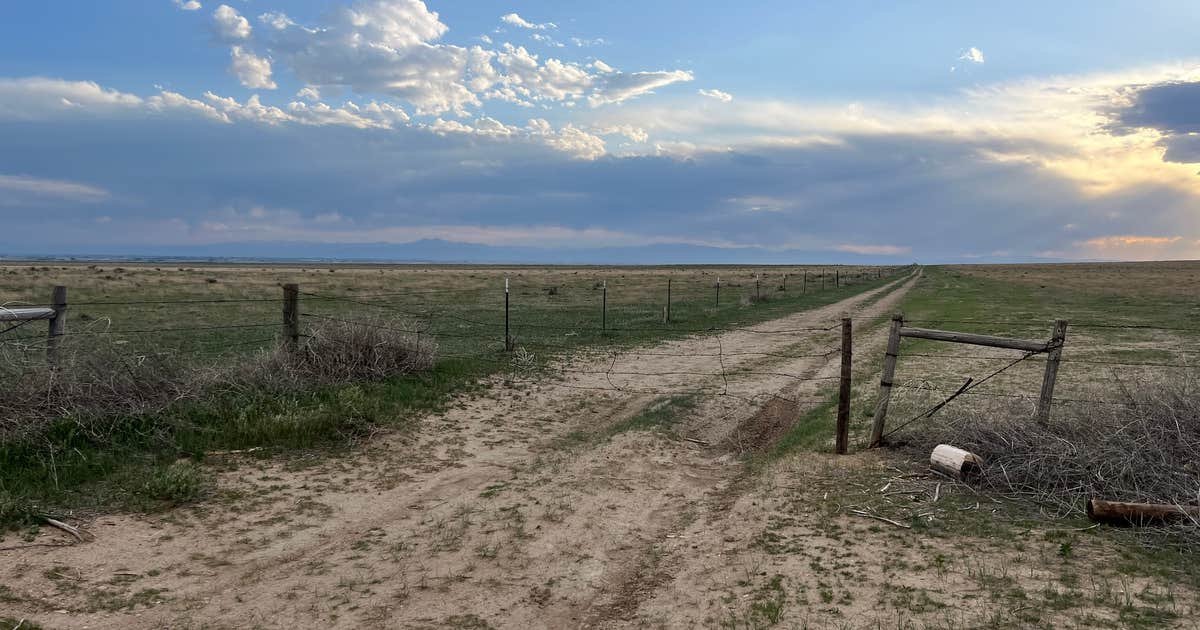
Trucks, a rail line and two state and federal highways meet in one small town at Ault, and that is the case for building a yard, a transload area or a cross-dock here. We build truck courts, stabilized laydown areas, rail-adjacent pads and the steel buildings that go with them for operators who need to move material between road and rail on the Weld County plains.
Ault sits at the intersection of US Highway 85 and State Highway 14, and SH 14 meets US 85 here before continuing east. The highway as a whole runs 236.92 miles, and its Weld County segment east of I-25 exit 269 passes through Ault, where it meets US 85 at about mile 153.4. A Union Pacific line runs north-south through town parallel to US 85, a Denver-to-state-line route that gives the town direct access to the railroad.
The town is small. It sits at 4,948 feet on 1.728 square miles, about 1,106 acres, and its population rose from 1,519 in 2010 to 1,887 in 2020. That scale is useful to a freight user, because land is manageable and neighbors are few, but it also means utilities and local staff are limited, which we plan for from the start.
A Crossroads Town on US 85
Most of what we build at Ault is shaped by the corridor. The two highways bring trucks from several directions, the rail line runs beside them, and the open land around town can take a laydown yard or a transfer facility without much neighborhood conflict. Compare it with Eaton to the south on the same highway, which has a developed rail park, and with Kersey, on the US 34 side of the county.
The road distances are what a transportation manager checks first: how many minutes to the interstate, to the nearest major city, to a competitor's dock. We run those numbers with the owner before buying land, using actual truck routes and not straight lines.
Dirt, Gravel and Concrete Under One Schedule
A yard is mostly earthwork and paving, and we manage both. Clearing, grading, compaction, aggregate base, concrete aprons and drainage are all within our scope, and a single foreman can sequence them so that trucks are never waiting on one trade. A rail-adjacent yard also needs careful grade control near the track so water drains away from the roadbed.
The details of a truck court depend on the traffic. A truck court or trailer yard that sees fully loaded tractors turning on a tight radius needs concrete in the turning zones and at the dock approach, while storage areas can use a thick aggregate or asphalt section. We specify each zone for the load it sees.
Rail-Adjacent Work and Transload Pads
Where freight moves between rail and truck, the site needs a hard, level surface beside the track, a clear path for loaders and trucks, lighting and a drainage plan. Our rail spur site improvements cover the civil work that surrounds a track: grading, ballast shoulders, crossings, utilities and pads. The track itself is built by the railroad or its approved contractor, and we coordinate the handoff.
The railroad's requirements govern anything within its right-of-way, including clearances, drainage and the design of crossings, and its review period must be built into the project calendar. Early contact with the railroad's industrial development staff avoids the common mistake of designing a site that the railroad later asks to change.
Planning Around Freight, Not Just Construction
Construction at a freight site depends on the arrival of materials as well as the work itself. Aggregate, concrete, rebar and steel all arrive by truck, and in a small town the supply plant may be a considerable distance away. We order concrete with enough lead time to guarantee the pour and schedule aggregate deliveries so the yard base can be placed in a continuous operation.
When a site is next to an active highway, the access permit from the state or county sets the pace. A new driveway onto a state highway needs a permit, and the review may require a deceleration lane or a turning bay. We submit that application early and design the driveway to the likely requirements.
Working Next to Track and Traffic
Two hazards define a job beside a rail line: the trains and the highway. Any worker within the railroad's right-of-way needs the railroad's training and flagging, equipment must not foul the track, and crane booms are kept clear of any overhead line. We verify the railroad's safety requirements and insurance terms before mobilizing, since being turned away at the fence costs a day of crews.
On the highway side, a traffic control plan protects workers where trucks enter and leave the site. Temporary signs, tapers and a flagger at the access are standard, and a good stabilized laydown yard built early keeps mud off the pavement. That one item prevents most complaints from the highway's maintaining agency.
Industries That Value a Rail and Highway Crossing
Companies in metals and heavy industry, agricultural input suppliers, building-material yards and bulk-commodity handlers are the typical users of a site like this. Their buildings are basic: a steel shop or storage building, a scale, a lot and a rail connection. A truck terminal or cross-dock follows the same logic, with doors and a yard sized for the number of trailers.
Because the town is small, the utility capacity should be verified early. Power, water and sewer service in a town of this size can be limited, and a heavy user may need its own transformer or well. We ask about both before any layout is finalized.
Give Us the Truck Count and the Track Distance
Send the daily truck volume, the commodity and the distance to the rail line. We will return a yard layout, a paving section by zone and a budget.
Common Questions
Is it possible to get rail service to a new site at Ault?
It can be, but it depends on the railroad's approval, the distance from the line and the volume you expect to ship. The railroad evaluates the proposal against its network, and the design must meet its standards. We help prepare the site plan and cost estimate you will need to start that conversation.
How should we think about a truck court versus a gravel yard?
Gravel is cheaper and works for storage and occasional traffic. Concrete or heavy asphalt costs more but handles turning trucks and heavy loads without rutting. Many projects use both, with concrete at the dock and in turning zones and aggregate elsewhere.
What approvals does a driveway on a state highway need?
An access permit from the state transportation department, reviewed for sight distance, traffic and spacing from other access points. The permit may require auxiliary lanes. We file early because the review period is outside our control.
Are utilities likely to limit a project in a town this size?
They can. Power and water capacity may need an upgrade, and the cost of the upgrade should be part of the feasibility study. We ask the serving utilities for written capacity statements before the owner commits to a lot.
Do you build the buildings as well as the yard?
Yes. We manage the erection of steel shops, storage buildings and small terminals, and the pours for their slabs and aprons. Having one contractor for both yard and building makes the drainage and grade work out between them.
Related
Related Services
Related Building Types
Related Service Areas
Ready to talk about your project?
Request a Project ReviewOne project team for the whole sequence
Industrial Contractors of Fort Collins reviews the site, the loads, the schedule and the approvals before pricing, then schedules, coordinates and inspects the specialty trade partners from preconstruction through closeout.