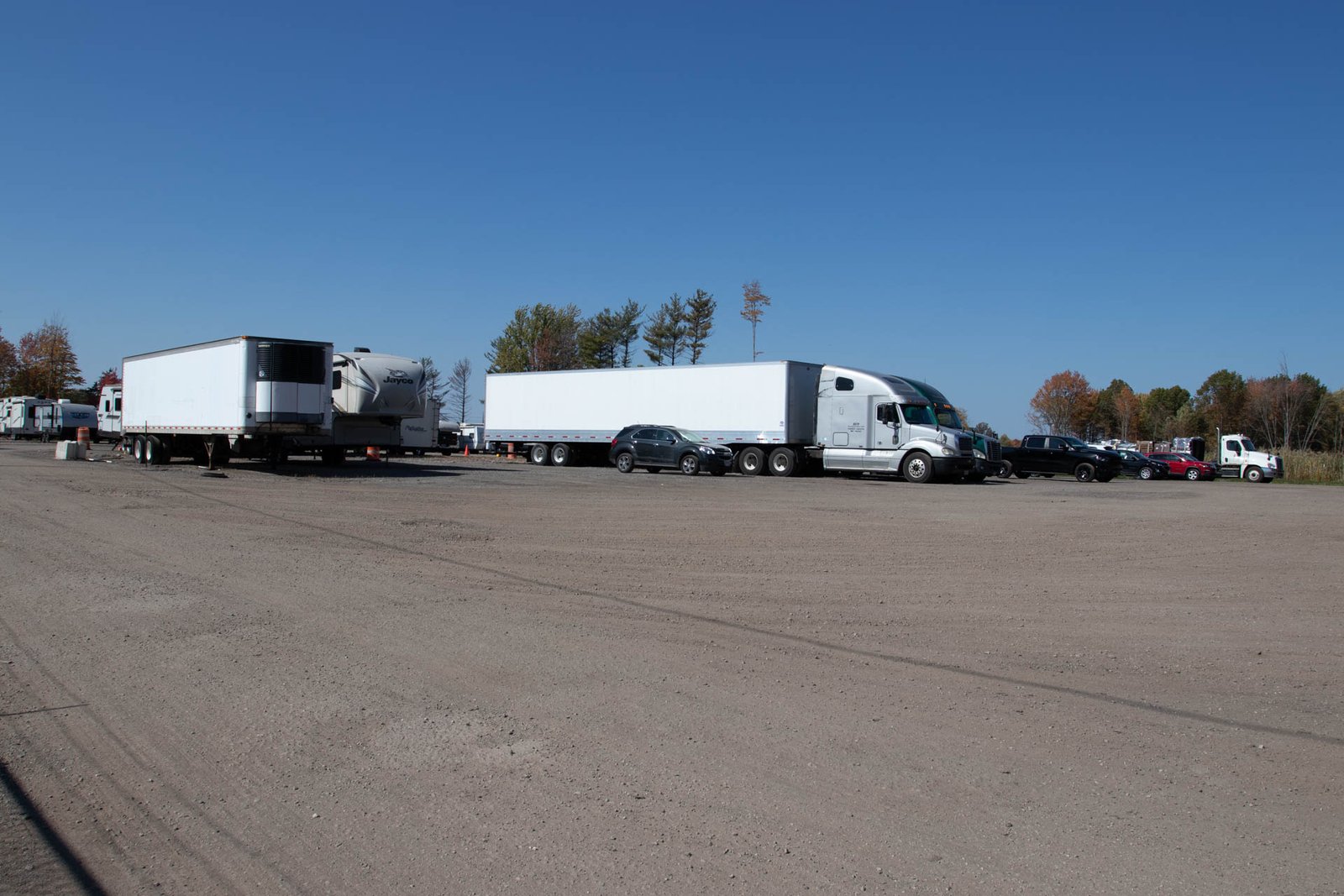
Dock doors tell a tenant less about a building than a fenced yard of about 0.6 acres with room for roughly 3.5 more acres. That is how a newly built 24,000 sq ft industrial building at the southeast corner of I-25 and Prospect Road is described, and it shows what operators ask for in northern Colorado: not only a shell, but a place for trucks to turn, trailers to wait and drivers to find the dock without help.
Truck courts and trailer yards are the working surface of a distribution or manufacturing site. They carry loaded tractor-trailers turning on a tight radius, trailers parked for days with the weight of their landing gear on a few square inches of pavement, and forklifts crossing the same area at speed. The paving, the base, the drainage and the layout all have to be built for that duty, not for the lighter traffic that a standard parking lot sees.
We design the yard with the building and build it as part of the same schedule, so it is ready when the first truck arrives.
What a truck court consists of
The work begins with subgrade preparation, because pavement is only as good as what sits under it. We proof roll, stabilize soft areas, place and compact base and then choose the surface. Heavy-duty concrete is the usual choice at dock aprons and trailer parking, where wheel loads concentrate, while asphalt is often used for the drive lanes and employee parking where the loads are lighter. The right combination depends on traffic, budget and the owner's maintenance plan.
Around the paving we build the elements that make a yard function: curb and gutter, trench drains at the dock, striping and trailer stall layout, light poles, bollards, fencing and gates, and the drainage that keeps the surface clear. For an owner who needs more stalls or a larger turning area later, we plan the expansion path before the first slab is poured. The adjacent dock aprons and loading zones are designed as part of the same system.
Corridors that move trailers
Trailers reach the northern Front Range by interstate and state route. I-25 runs along the east side of Fort Collins, and State Highway 14 leaves downtown along East Mulberry Street and reaches the interstate at exit 269. CDOT's I-25 and Mulberry (CO 14) Interchange Improvements project covers I-25 mileposts 269 to 271 and cites unconventional traffic operations, flooding concerns and aging infrastructure, so truck access to sites near the Mulberry and I-25 interchange is likely to change over time.
That uncertainty affects the yard design. A site whose approach roads may be rebuilt should be designed with a driveway that can be adapted, and a turning analysis that works with more than one approach geometry. Rail is a further factor: freight rail service in Fort Collins is provided by Union Pacific and BNSF, and industrial sites with rail access divide their yards between trucks and trains. The Timberline and Prospect industrial area sits within reach of these routes, and yards there are designed with them in mind.
Paving, joints and details we control
Concrete yards fail at joints and edges, not in the middle of the slab. We place concrete with dowelled contraction joints sized to the pavement thickness, saw the joints at the right time, seal them and cure the slab. Edges and transitions receive extra attention, because the first place a trailer turns hard is the first place a joint fails. Where a heavy trailer's landing gear will sit, we thicken the slab or add a pad to spread the load.
Asphalt areas receive the same care in base preparation and compaction, with tack coats, lift thickness and temperature controls that suit Colorado weather. We hold surveyed grades so water drains toward inlets and does not pond near doors. By managing these steps under one project team, we keep the schedule and quality in one place. When pavement meets heavy haul access roads, the pavement sections are matched so there is no abrupt change in strength.
Where yard cost comes from
Pavement area and thickness carry the largest share. A yard sized for a single tenant is cheaper than a yard sized for several, but expanding a built yard is expensive because of the demolition and drainage changes involved. We price the first phase and the expansion separately so an owner can compare building the extra area now with building it later.
Subgrade condition and drainage are the other major drivers. Soft soils need stabilization, and a site with a long drainage path may need more storm sewer than a flat one. Fencing, gates, lighting and security systems add cost, and their level depends on what the yard stores. Operators of logistics and distribution yards often invest more in lighting, cameras and gates than in the paving thickness.
Yards across the corridor
We build yards from Fort Collins south through Loveland and Berthoud, and east into the Weld County towns along US 85 and State Highway 14. Centerra Industrial in Loveland, half a mile from I-25 with dock-high loading, has the kind of truck access that tenants expect. The truck terminal and cross-dock buildings that serve the corridor need yards of different dimensions, with doors on both sides and long staging lanes.
Each community applies its own standards for driveway spacing, turning radii, fencing height, screening and outdoor storage, and some limit trailer parking visible from the street. We confirm the local rules before the site plan is submitted and design the yard to pass the first review. That is cheaper for the owner than a second submittal, and it keeps the schedule on track.
Describe the trucks, the stalls and the growth you expect
Send the site plan, the dock count and the trailer volume. We will return a yard layout, pavement sections and a price for the first phase and the expansion.
Common Questions
Should we choose concrete or asphalt for the trailer yard?
Concrete performs better where wheel loads are heavy and concentrated, such as dock aprons, trailer parking and turning areas. Asphalt costs less and works for drive lanes and light traffic. Many yards use both. We price each section separately and recommend a mix based on your traffic and maintenance plan.
How big should the yard be?
It depends on the number of dock doors, the trailer dwell time and the turning radius. A common rule is to count stalls, drive lanes and turning areas for the peak day, and then to reserve space for expansion. The yard described at I-25 and Prospect Road has about 0.6 acres fenced with room for about 3.5 acres more, a useful illustration of reserving growth.
What about drainage in a paved yard?
A large paved area sheds water quickly, so the yard needs inlets, a storm system and often detention. We set grades to move water away from doors and to avoid ponding in trailer stalls. The design is coordinated with the stormwater plan, and the yard is surveyed before paving.
Can a yard be built in winter?
Concrete can be placed in cold weather with proper protection, and asphalt has temperature limits. We plan paving for seasons that suit the material and use winter for earthwork and underground work. If winter paving is unavoidable, we propose methods to protect quality.
Who maintains joint sealant and striping?
The owner, after the warranty period. We give a maintenance guide with the closeout documents that lists inspection intervals, sealant types and repair methods. Regular attention to joints is the cheapest way to extend pavement life.
Related
Related Services
Related Building Types
Related Service Areas
Ready to talk about your project?
Request a Project ReviewOne project team for the whole sequence
Industrial Contractors of Fort Collins reviews the site, the loads, the schedule and the approvals before pricing, then schedules, coordinates and inspects the specialty trade partners from preconstruction through closeout.