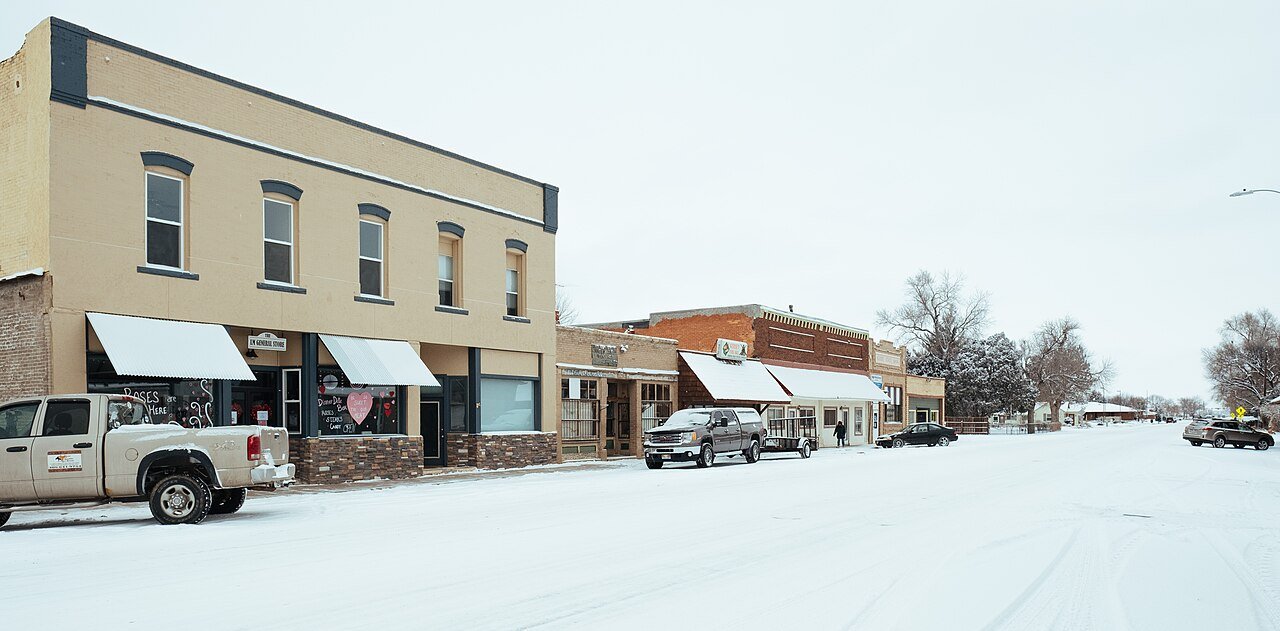
Groundwater decides how a building goes up on the South Platte, and Kersey sits on that river. Our approach to a site there begins with test borings and a groundwater reading, because a floor that is poured into a wet excavation or a footing set below the water table behaves very differently from one built on dry ground. We build shops, storage buildings, equipment pads and yards for owners in and around Kersey, with the dewatering, drainage and foundation details that river-bottom ground requires.
Kersey sits at 4,623 feet in Weld County and had 1,454 residents in 2010 and 1,495 in 2020, so it is a stable small town, not a boomtown. Elbridge Gerry set up a trading post, Fort Gerry, on the South Platte River near present-day Kersey in the 1830s, which is a reminder that the river has drawn commerce to this spot for a long time. US 34 runs about 260 miles across Colorado east of Greeley, crosses the South Platte River, and its Weld County junction list includes County Road 53 at Kersey.
That highway link to Greeley is the practical asset. Operators who want a lower-cost site with easy truck access to a larger city find that Kersey fits, provided the ground and the approvals line up.
Shallow Water and Soft Ground
Soils near a major river are often alluvial: layers of sand, gravel and silt with groundwater close to the surface. That ground can be excellent for bearing, but it can also be loose, saturated or variable over short distances. We investigate before we design, with borings to a depth that reveals the water table and the layers beneath the footing, and we place monitoring wells where the seasonal swing in groundwater matters.
Construction methods follow from what we find. A shallow water table may call for dewatering during excavation, a thicker gravel base under the slab, a vapor barrier and, for buildings with a basement or a pit, waterproofing. Our deep foundations and piers are the fallback if the upper soils cannot carry the load, and we price both options before the owner decides.
Drainage First, Building Second
On flat ground beside a river, water leaves the site slowly. We lay out grades so that every part of the yard drains positively, set the finished floor above the surrounding ground and the likely flood level, and size detention to handle a design storm. Our stormwater detention and drainage work starts at the outfall, which is the point where water leaves the property, and works backward to the building.
It also means being deliberate about fill. Imported fill raises a building above the water table but takes space and money, and it must be compacted and tested. We balance the earthwork on site where possible, and we document the compaction so that the owner and the inspector see the same record.
Pads, Shops and Yards for Rural Operators
The projects we see around Kersey serve working businesses: a steel shop for a service company, a pad for a compressor or tank, a laydown yard for equipment and a gravel or concrete truck area. A pre-engineered metal building is the usual shell, with a slab-on-grade foundation, and a concrete floor with a wash-down drain where the use calls for it.
Yards take wear from trucks and equipment, so we build the base thick enough for the load. Where an old slab or foundation stands on the parcel, the trade partners for demolition and slab replacement remove it and prepare the ground for the new work.
Where the Budget Goes on a River Parcel
The cost differences between two similar parcels near a river are almost always underground. Fill to raise the pad, dewatering during excavation, thicker aggregate under slabs and yards, and the length of utility extensions each move the budget by amounts that a standard per-square-foot figure does not capture. We show the owner a site-condition allowance with the assumptions written out, and we replace it with actual numbers when the borings come in.
Power is the other recurring question. A three-phase service to a rural parcel can mean a long line extension and a transformer, and the utility sets its own timeline and charges. We request the utility's estimate at the feasibility stage and carry its lead time in the schedule, since a building that is finished but not energized produces no revenue.
Working With the River Calendar
Groundwater on the South Platte follows the irrigation season and the spring runoff, and it tends to be highest when ditches are running. We schedule excavations and deep utility work for the period when the water table is lowest, and we plan dewatering equipment for the periods when it cannot be avoided. A foundation placed in dry conditions is easier to inspect and less expensive to build.
Winter has its own constraints. Frozen ground slows excavation and compaction, and concrete needs protection from cold. We aim to have footings and slabs complete before hard freezes and to enclose the building for finishing work in the colder months.
Nearby Markets and Permits
Kersey is a short drive from Greeley along US 34, and from Evans, which shares the same river corridor. Owners often compare sites in the three, and we help weigh land cost, haul distance and permitting.
The building code for an unincorporated Weld County parcel is the 2024 International Building Code effective June 15, 2026, with engineered foundation designs required for most new structures. A parcel inside the town follows the town's own adoption, which we confirm directly. For food and beverage users or any business with wash-down needs, drainage and discharge permits are the items to raise with the serving authorities at the outset.
Start With a Boring and a Groundwater Reading
Send us the parcel and the use. We will arrange borings, check the floodplain and return a foundation approach with a price.
Common Questions
Will groundwater make construction on a Kersey parcel more expensive?
It can, depending on how shallow the water is and how deep the foundation needs to go. Dewatering, a thicker gravel base and moisture protection add cost, but they are manageable when known in advance. A boring and a groundwater reading cost very little compared with discovering the water during excavation.
Do I need an engineered foundation here?
For most new structures in unincorporated Weld County, yes, under the code effective June 15, 2026. Even for a parcel inside the town, we recommend a geotechnical report, because river-bottom soils vary so much.
Is flooding a concern for a building near the South Platte?
It depends on the parcel's position relative to the mapped floodplain. We request the mapping early, set the floor elevation accordingly and design the drainage so that the site does not add to flooding of its neighbors.
How do trucks reach Greeley from a Kersey site?
By US 34 through the county junction at County Road 53 in Kersey. The highway carries the traffic toward Greeley and the larger roads beyond, and we check the intersection and driveway design with the highway authority before locking the site layout.
Can you build a small project economically in a small town?
Yes. A small project's cost comes mostly from site work and the shell, and we keep both simple. We use standard steel buildings and repeatable details so the owner pays for performance and not for custom engineering.
Related
Related Services
Related Building Types
Related Service Areas
Ready to talk about your project?
Request a Project ReviewOne project team for the whole sequence
Industrial Contractors of Fort Collins reviews the site, the loads, the schedule and the approvals before pricing, then schedules, coordinates and inspects the specialty trade partners from preconstruction through closeout.