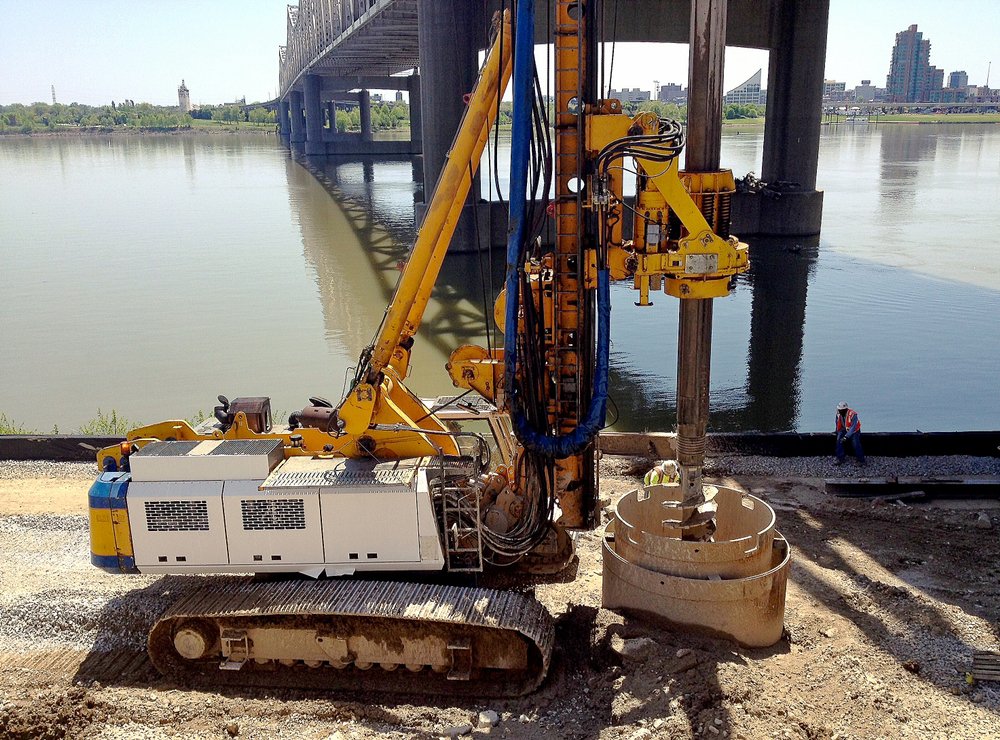
Where the South Platte and the Cache la Poudre shape the ground, the foundation question is rarely answered by the building plan alone. The South Platte River bounds the Greeley and Evans area on the south, the Cache la Poudre runs through north Greeley and Fort Collins, and the soils between them range from stiff clays to river gravels with groundwater that rises and falls with irrigation season. A heavy industrial structure on that ground may sit on shallow footings, or it may need a deep foundation system to reach a bearing layer that can carry the load without settling.
Deep foundations are the family of systems that do that: driven piles, helical piers, micropiles, drilled shafts and auger-cast piles. We help owners and design teams choose among them and we build the systems that suit the site. The choice depends on loads, soil profile, groundwater, access, noise limits and schedule, and it is better made in preconstruction than after the first boring log arrives late.
Our work in this area is closely tied to drilled pier foundations, the most common deep system on the Front Range, and to the equipment and structural scopes that bear on the piers, such as equipment pads and foundations.
Rivers, floods and what they mean underground
The Cache la Poudre is subject to sudden, destructive floods. An 1864 flood destroyed Camp Collins at La Porte, and the city still experiences periodic flooding from the river. A late July 1997 flash flood in Fort Collins followed 10 to 14 inches of rain over 31 hours, killed five people and caused about $140 million in damage to Colorado State University. Those events matter underground because they show how saturated the near-surface soils can become and how scour and groundwater can change a site over a few hours.
An industrial building near a river corridor therefore needs foundations designed for high groundwater, potential scour and uplift. Deep foundations help by reaching below the zone that moves, but only if the design accounts for the water table, the potential for soil softening and the extra loads on shafts that pass through weak layers. We make sure those conditions are known before a system is chosen.
Choosing between pier, pile and helical systems
Drilled shafts handle high loads and can be inspected as they are built, but they need a drilling rig and, in wet ground, casing or slurry. Driven piles are fast and produce no spoil, but the noise and vibration may not suit a site near neighbors or sensitive equipment. Helical piers install quickly with small equipment and are useful for lighter structures, additions and tight access. Micropiles reach rock or dense layers in confined areas and handle both tension and compression.
The right system also depends on who will inspect and what happens if something differs from the boring log. A drilled shaft shows its soils as it is drilled, which gives the engineer real information; a driven pile gives a driving record. We ask the geotechnical engineer to state the assumptions behind the recommendation, and we price alternatives so the owner can compare cost, schedule and risk on the same basis.
Engineered foundations and the review process
Unincorporated Weld County adopted the 2024 International Building Code effective June 15, 2026, with engineered foundation designs required for most new structures. Fort Collins uses the 2024 International Building Code with local amendments for permits submitted on or after April 1, 2026. Whichever jurisdiction applies, a deep foundation is designed by a licensed engineer from the geotechnical report, and the plan reviewer will expect load tests, special inspections or both.
Special inspection is where deep foundation work is checked: the inspector observes depths, diameters, reinforcement, concrete placement and, for driven or helical systems, installation records. We schedule the inspector, supply the records requested and keep the field documentation current. Where load tests are required, we plan the test setup and the time to run it before the production schedule depends on the result.
Preconstruction on the ground before steel
The early months of a project are the cheapest time to learn about the ground. We recommend that owners commission additional borings at the footprint of heavy loads, and that the geotechnical engineer give a recommendation for at least two foundation systems. In preconstruction we run those options against the building structure, crane and equipment loads, schedule and budget.
During construction we survey every shaft or pile location, document installation, and report conditions to the engineer immediately when something differs. Having a clear line of communication prevents the kind of surprise that stops an excavation for a week. For plants in metals and heavy industry or utilities and power, where loads concentrate in a few foundations, this attention pays off.
What decides cost and schedule
Cost depends on count, depth, diameter, and the difficulty of the ground. Groundwater adds casing, dewatering or slurry; cobbles, debris or hard layers slow drilling; tight access forces smaller equipment and slows the cycle. Mobilization is a fixed cost, so a few large piers can cost more per foot than many small ones. We provide unit prices for additional depth, because the actual depth is usually revealed during production.
Schedule follows the same pattern. A rig can drill a set number of shafts a day under good conditions, and each needs reinforcing steel and concrete. We coordinate the cage fabrication, concrete supply and inspections so the rig does not wait. Buildings such as manufacturing plants and data centers that are on tight delivery dates should have their foundation procurement locked before design is complete.
Settle the foundation system early
Send us the geotechnical report and the structural load schedule and we will outline foundation options with cost and schedule. For buildings in the Greeley area, we can also review conditions in Greeley and Evans before the design is final.
Common Questions
How do I know whether my site needs deep foundations?
Your geotechnical report will say. It compares the loads of the proposed building with the bearing capacity and settlement of the near-surface soils. If shallow footings would settle too much or sit on weak or expansive layers, the engineer will recommend deep foundations or ground improvement. We can help review the options.
Can piers be built near the river without disturbing the water?
Work near rivers is regulated, and permits may apply. We use casing, containment and sediment controls and keep drilling spoil away from the channel. In flood-prone areas we also check that the foundation top elevation and any basement openings satisfy the local floodplain requirements.
What is the difference between a drilled pier and a drilled shaft?
In common usage they mean the same thing: a cylindrical concrete foundation cast in a drilled hole. Some designers use "pier" for smaller diameters and "shaft" for larger ones. The key point is the diameter, depth, reinforcement and bearing layer shown in the structural drawings.
How long do deep foundations take?
The rig production rate varies with soils and diameter, but most industrial projects take days or a few weeks rather than months. The larger risk is the lead time to mobilize a rig and to get reinforcement and inspection ready. We schedule those items in parallel with design to protect the date.
Do deep foundations cost more than shallow footings?
Per footing, yes, but the right comparison includes the cost of settlement, ground improvement and risk. For heavy or settlement-sensitive structures, a deep system can be the more economical and reliable choice. We provide side-by-side numbers when the geotechnical report supports more than one option.
Related
Related Services
Related Building Types
Related Industries
Related Service Areas
Ready to talk about your project?
Request a Project ReviewOne project team for the whole sequence
Industrial Contractors of Fort Collins reviews the site, the loads, the schedule and the approvals before pricing, then schedules, coordinates and inspects the specialty trade partners from preconstruction through closeout.