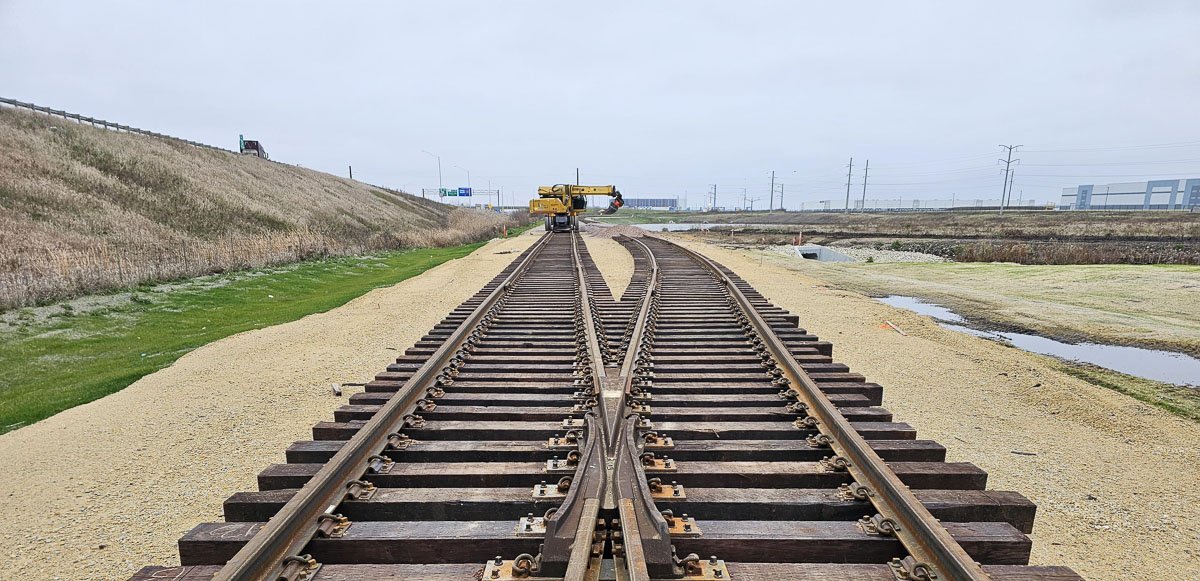
Before any ballast is ordered, the railroad has to accept the design. That is the first fact of rail-served industrial work, and it shapes everything we do on a spur project: the site plan has to leave room for the turnout and the lead track, the grading has to meet the railroad's profile limits, and the schedule has to include review time that no contractor controls. We build the site-side portion of a spur, meaning the subgrade, drainage, crossings, loading areas and the surrounding yard, in step with whatever the serving railroad or its track contractor installs.
Two Class I railroads reach this metro. Freight rail service in Fort Collins comes from Union Pacific and BNSF, and the city has no intercity passenger rail, which keeps the corridor focused on freight. Further east, Union Pacific's Eaton Industrial Rail Parks total 160 acres zoned I-2 with parcels divisible to a 1 acre minimum, unit train and manifest service available, and Union Pacific approval of a 10 percent design for new rail service. For an owner, that last point matters: it means rail access on a parcel there is a pathway, not a hope.
Our role is to make the parcel ready to receive rail and to make the plant work with it once trains arrive. That means coordinating with the site clearing and mass grading contractor, the underground utilities, and the dock aprons and loading zones that will sit beside the track.
Railroad review, easements and permits
A new spur usually involves an industry track agreement with the serving railroad, a design submittal with its engineers, and in some cases easements or crossing permits with the local jurisdiction. Union Pacific describes a 10 percent design approval as a step for new rail service at Eaton, and similar reviews apply elsewhere. The railroad specifies track geometry, clearances, switch placement and crossing protection, and its requirements govern over the owner's preferences.
We read the railroad's standards before we price the site work, because they dictate grading tolerances, drainage and the stationing of fixed objects. Items like buildings, poles, fencing and loading equipment must clear the track by distances the railroad sets, and moving a building after review is far more costly than adjusting a drawing. We also verify utility crossings with the railroad early, since boring beneath a track needs its own approval.
Where rail access carries weight
Great Western Industrial Park in Windsor is a 3,000-acre master-planned park with dual rail interchanges to Union Pacific and BNSF, sites from 5 to 200 acres and industrial buildings from 60,000 to 1,000,000 sq ft. Tenants have included makers of wind turbine blades, composite materials, imaging products, and food and energy products. That diversity of rail users shows how much the demand for loading, unloading and storage varies from one plant to the next.
Windsor also has a BNSF line running north of Main Street, and the town's State Highway 392 business district shows how close rail and the community can be. A spur on a nearby parcel has to account for street crossings, noise and neighbors, as well as the railroad. We help owners think through where the track will run, how often cars will be switched, and whether a loop, a stub or a dual-ended layout suits their volumes.
The work we manage around the track
Track installation is usually done by the railroad or a specialist rail contractor, but much of the surrounding work is ours. We prepare the subgrade and subballast, build the drainage that keeps the track dry, and install the crossings, aprons and concrete pads that make the track useful. Where cars are unloaded at the plant, we construct the unloading pits, transfer pads, containment and curbs that handle liquids and bulk materials.
We also build the yard around the track. That includes truck circulation, crane and forklift routes, lighting, and the security elements that control access to the rail area. Our trade partners work to the railroad's grade and clearance tolerances and coordinate with the track contractor so that each trade finishes before the next one needs the ground.
Drainage, loads and long cars
Rail beds are sensitive to water, and a spur built across a flat site can become a drainage collector if it is not designed carefully. We shape the grading to carry water away from the ballast section, add ditches or underdrains where needed, and protect the track from stormwater flowing across the yard. We also keep a close eye on the transition between track and pavement at crossings, where mismatched settlement shows up first.
Car loads are heavier than road loads, and the equipment that unloads them adds more. Concrete pads for unloading, scales and storage should be designed for rail-served equipment and tied into the equipment pads and foundations scope. Long cars also need long clear lengths and wide turning radii, so site plans that treat the rail as an afterthought tend to run out of room.
Working beside live track
Safety rules around railroads are strict and specific. Work within a certain distance of an active track typically requires railroad-approved flagging, safety training and often insurance specific to the right-of-way. We budget for those requirements, we train our site staff and trade partners, and we schedule work with the railroad's flagger rather than hoping for a gap.
On the plant side, we separate people from rail movements with fencing, lighting, signage and defined walkways, and we give the owner a layout that supports a switching plan. Industrial owners in metals and heavy industry and logistics and distribution often use these elements to keep rail work clear of pedestrian paths and truck lanes.
Setting a realistic schedule
Our schedules treat railroad review and material lead times as critical items. A switch, special trackwork or crossing panels can have long procurement times, and the railroad may need its own crews to be available on a particular date. We build site schedules around those dates and avoid committing to a first-car date until the railroad has confirmed its portion.
When the site work is ready before the track, we protect the prepared subgrade and ditches so they do not need rework. When the track arrives earlier than the site, we sequence the pads and aprons so that rail service can begin before every detail is finished. In Eaton and Windsor, where rail-served parcels are marketed to industrial users, this sequencing is usually the part of a spur project that decides the opening date.
Bring the railroad into the plan early
If you have a parcel with rail potential, send us the site plan and the railroad correspondence and we will map the grading, drainage and loading work around it. We also prepare comparisons with truck-only layouts such as truck courts and trailer yards when rail does not pay off.
Common Questions
How long does it take to get a new rail spur approved?
The time is driven by the railroad, not by construction, and varies with the complexity of the connection and the railroad's workload. The first step is usually a design review of the track layout, followed by an industry track agreement and a construction schedule. We ask owners to start this process before final site design so that nothing built has to be moved.
Who builds the track and who builds the site?
The railroad or a rail contractor installs the track and turnouts. We build the grading, drainage, crossings, aprons, unloading pads and the rest of the plant yard. We coordinate with the track contractor so each crew has access when it needs it.
Can I add a spur later if I build the plant first?
You can, if the site plan reserves the corridor. We recommend leaving a protected right-of-way, keeping buildings and utilities out of it, and grading the area to a profile the railroad can use. A plant that boxes in its own spur corridor may find rail access impossible without demolition.
What are the main site risks around a rail spur?
Drainage, clearances and utility crossings are the common ones. Water that reaches the ballast section undermines the track, objects too close to the rails create conflicts, and utilities crossing the track need separate railroad approval. We address each of these in design and pricing rather than in change orders.
Does rail access make sense for a smaller manufacturer?
It can, particularly if the plant receives bulk materials or ships heavy products. Smaller operations often share a spur or use a transload arrangement at an industrial park. We help owners compare the cost of building a private spur with the cost of trucking from a transload site.
Related
Related Services
Related Industries
Related Service Areas
Ready to talk about your project?
Request a Project ReviewOne project team for the whole sequence
Industrial Contractors of Fort Collins reviews the site, the loads, the schedule and the approvals before pricing, then schedules, coordinates and inspects the specialty trade partners from preconstruction through closeout.