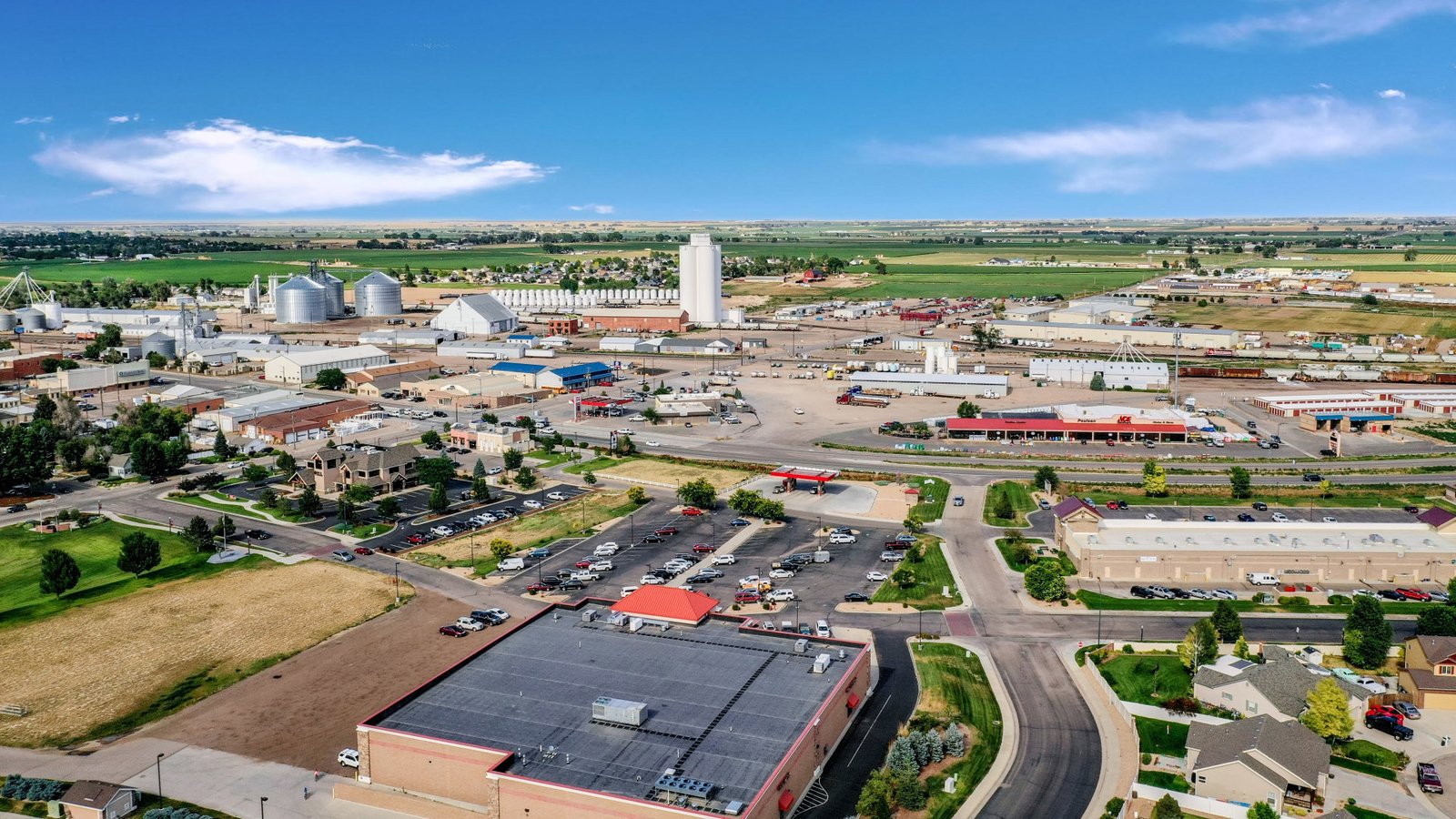
Before a rail-served plant can break ground, its owner needs the railroad to approve a 10 percent design of the new track, and that review sets the pace of the whole project. At the Union Pacific Eaton Industrial Rail Parks, that approval step is part of how new rail service is offered, and we plan industrial buildings, yards and utilities around it so that the track, the building and the paving finish in the right order.
The parks, North and South, total 160 acres zoned I-2, with parcels divisible to a one acre minimum, unit train and manifest service available, and Denver metro within an hour's drive and Denver International Airport within 50 miles. Eaton lies on the Denver to state-line mainline of the Union Pacific Railroad, along US 85 about 7 miles north of Greeley. US 85 meets SH 392 in Lucerne, passes through Eaton and meets SH 14 in Ault.
For a company shipping bulk product, building materials or packaged goods, those details define the site's value. Our job is to turn a parcel into a working facility: the foundation, the building, the loading area, the utilities and the rail-side surface.
Why Rail Parks Draw Specific Users
A rail park serves shippers whose cost depends on moving heavy material cheaply. Unit-train and manifest service describe two different ways to ship: a unit train carries a single commodity in a block of cars to one destination, while manifest service moves mixed cars on a regular schedule. The user's volume decides which fits, and the volume in turn decides how much track, how long a loading area and how large a building the site needs.
Eaton's neighbors play their own roles. Greeley is the larger market and labor pool to the south, and Ault offers a smaller highway-and-rail crossing to the north. A buyer comparing the three will find the rail park's formal structure and parcel sizes the main difference.
From Parcel to Operating Facility
On a typical parcel we start with rail spur site improvements: grading and drainage beside the track, the pad and apron where cars are loaded or unloaded, crossings and fencing. Next come the utilities, the foundations and the building, which is commonly a steel-framed warehouse or processing structure. A one-acre parcel and a thirty-acre parcel need different approaches, and we scale the project to fit.
Where an owner wants a single contractor to carry design and construction, our industrial design-build team works with the railroad's requirements from the first sketch and keeps the building, the track clearances and the truck circulation consistent with one another. That avoids the typical conflict in which a building is positioned for trucks and then found to be too close to the track.
Sequencing Track, Slab and Steel
The order of work in a rail-served project matters because the track and the building depend on each other. The railroad's design approval comes first, then site grading and utilities, then foundations and the slab, then the building shell, and finally the track and the loading surface so that heavy equipment does not damage finished work. We coordinate with the railroad's contractor on the date when track installation can begin.
Long-lead items can control the schedule. Steel, electrical gear and process equipment often take longer to arrive than the site work takes to finish, and our long-lead procurement management brings those orders forward so that the building is not waiting on a delivery.
Zoning, Fire Water and Storage Hazards
I-2 zoning tells an owner that heavy industrial uses are intended, but each use still has to satisfy fire, environmental and building rules. Bulk storage of fertilizer, fuels, grain or chemicals brings separation distances, secondary containment and fire-flow requirements, and these can shape the layout of a parcel as much as the track does. We bring the fire authority into the layout discussion early, and we design the water supply, whether a main extension or an on-site tank, to its flow demand.
Small parcels in a rail park put neighbors close together. A building and its yard should be laid out so that a truck waiting to load does not block a rail crossing or a neighbor's entrance, and we draw the turning paths to check that before anything is built.
Rail Is a Capital Decision
New track, switches and crossings are among the largest items on a rail-served budget, and they are set by the railroad's standards rather than by market bids alone. We separate the rail portion of the estimate from the building and site work, so the owner can judge the return on rail independently and see what portion of the project depends on a particular volume.
Foundation cost is the second driver. Unincorporated Weld County adopted the 2024 International Building Code effective June 15, 2026, with engineered foundation designs required for most new structures, so a geotechnical report and a stamped design are part of the early cost for any county parcel. A heavy rack, bin or tank foundation costs more than a standard slab, and we price those items separately.
Buildings and Industries That Fit
Rail parks suit logistics and distribution users with large volumes, and warehouses with a rail door and a truck dock are the common building. Agricultural, food-related and building-materials businesses use the same logic with a processing room or a bagging line inside.
Irrigation also matters here: much of the farmland around Eaton depends on irrigation systems engineered by the Eatons and others, so ditches and laterals cross many parcels and have to be addressed in the site plan, as they would be anywhere on the plains.
Start With the Commodity and the Annual Volume
Tell us what you ship, how much and how often. We will outline the track, building and yard together and give you a price that separates the rail portion.
Common Questions
What is a 10 percent design for new rail service?
It is a preliminary design of the track layout, roughly a tenth of the way to final drawings, that the railroad reviews to confirm that the proposed service fits its network and standards. Approval lets the owner proceed to detailed design. We prepare the site plan data that goes into it.
How small can a parcel be in the rail parks?
The parks list parcels divisible to a one acre minimum, though rail service for a small parcel depends on how it connects to the track. We review the layout with the railroad before an owner commits to a particular size.
Do we need an engineered foundation on a county parcel?
For most new structures in unincorporated Weld County, yes, under the code that took effect June 15, 2026. A geotechnical investigation and a stamped foundation design are required inputs, and they should be included in the early budget.
How long does it take to bring rail service to a new building?
The time depends on the railroad's design review, its construction schedule and the owner's own readiness. We cannot speak for the railroad, but we can line up the site and building work so that they are ready when the track is.
Can I build cold storage or food processing in a rail park?
If the zoning allows it, yes. Refrigerated buildings need heavier slabs with insulation, vapor control and larger electrical service, and we have the experience to design those into a shell.
Related
Related Services
Related Building Types
Related Service Areas
Ready to talk about your project?
Request a Project ReviewOne project team for the whole sequence
Industrial Contractors of Fort Collins reviews the site, the loads, the schedule and the approvals before pricing, then schedules, coordinates and inspects the specialty trade partners from preconstruction through closeout.