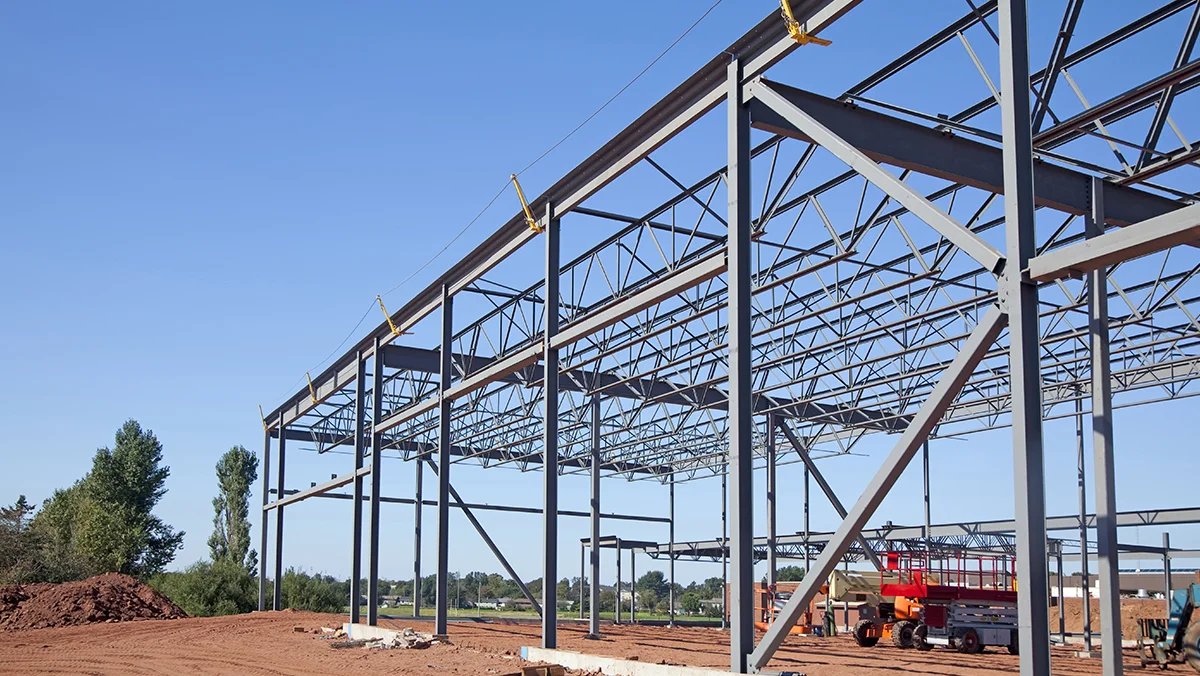
Design funds for the I-25 and Mulberry interchange were secured in September 2022, and as of August 2024 construction funding had not been identified. That one fact explains how public work behaves in this region: needs are identified early, design moves in stages, and construction waits for funding that arrives on the owner's timetable. A contractor serving cities, counties, districts and utilities has to plan for that rhythm and be useful in the long stretch before a notice to proceed.
We build for public owners in the way we build for plant managers: by being specific about scope, procurement and risk. Municipal buildings range from service centers, fleet shops and water or power facilities to recreation centers, public safety buildings and offices. Many of them are industrial in character, with large bays, yards, fueling, wash systems and heavy slabs, which is where our experience applies most directly.
The sections below cover the code and approval environment, what drives public project costs, and how we deliver on projects that must meet open procurement and audit requirements.
Code editions differ across the jurisdiction line
Commercial building codes in Colorado are adopted city by city and county by county rather than as one statewide code. Fort Collins treats the 2024 International Building Code with local amendments as the current code for permits submitted on or after April 1, 2026, and keeps the 2021 codes available for reference until October 1, 2026. Unincorporated Weld County adopted the 2024 International Building Code effective June 15, 2026, with engineered foundation designs required for most new structures.
For a public owner with facilities in several jurisdictions, such as a utility, a district or a county, the same prototype building may need to be reviewed against different editions and amendments. Colorado HB22-1362 also requires any county or municipality that updates a building code on or after July 1, 2023 to adopt an energy code with equivalent or better performance than the 2021 IECC, and from July 1, 2026 the benchmark becomes the state model low energy and carbon code. We confirm the edition and energy requirements for each site and carry them into the cost estimate.
Public work around highways, airports and historic districts
CDOT's I-25 and Mulberry (CO 14) Interchange Improvements project covers I-25 mileposts 269 to 271 and CO 14 frontage road connections from milepost 138.7 to 139.25, and cites unconventional traffic operations, flooding concerns and aging infrastructure, with bridge replacement and flood mitigation among its stated benefits. Public infrastructure of that scale reshapes the land around it, and adjacent private and municipal owners have to plan for it. Our Mulberry and I-25 interchange page describes what that means for nearby sites.
Shared public assets are common too. Loveland and Fort Collins own Northern Colorado Regional Airport 50/50 through a commission, which shows how municipal owners partner on facilities that serve a region. Greeley is pursuing FAA Part 139 certification for its own airport, a path that carries hangar, taxiway and pavement needs. Our pages on Greeley and Ault describe other public corridors where we work.
Procurement-aware preconstruction
Public owners rely on defined procurement paths, such as competitive bid, construction manager at risk or design-build, and each has a different role for the contractor. We tell owners plainly what each path does to schedule, risk and cost, and we help build bid packages that can be priced fairly. A clear scope and a complete set of site information reduce change orders more reliably than any contract clause.
During construction, we keep the documentation public owners need: daily logs, submittals, certified payroll where required, test reports, schedule updates and open pay applications. We also keep stakeholders informed, since public projects have neighbors, councils and utility partners who read the schedule too. Where demolition is part of the scope, the trade partners for demolition and slab replacement can prepare the site for new work.
Why public budgets are tight and how we help
Public budgets are often set years before bids, so escalation is a known risk. We help owners keep ahead of it by pricing early, identifying long-lead items, and breaking the project into packages that can be bought as funds are available. For a service yard, for example, the site utilities, grading and paving can be bid ahead of the building to lock in the foundation of the work.
Operating cost counts alongside first cost. Public owners keep buildings for decades, so we compare life-cycle options for roofing, mechanical systems, lighting and paving. Our yard lighting and electrical site work is a typical example, where efficient fixtures and well-sized conduit reduce long-term maintenance.
The public building portfolio
Public portfolios include city halls and offices, which share their structure with office buildings, and school facilities, which we treat under education and school projects. Public works buildings, fleet garages, water and wastewater facilities and transit maintenance buildings are closer to industrial work, with large bays and wash and fuel systems.
Utilities form another category. Substations, control buildings, operations centers and service yards require careful coordination with the utility's engineers, and they call on skills used in the utilities and power industry. We build those to the owner's standards, with security and redundancy specified from the beginning.
Waiting for funding without losing time
Many public projects wait for funding, voter approval or grant cycles. During that interval we can support the owner with site investigations, utility surveys, cost updates and phased packages. That work does not commit the owner to construction but shortens the path once approval arrives.
When the notice to proceed does come, the schedule is usually fixed by a funding or occupancy deadline. We sequence long-lead orders, site work and enclosure to protect that date, and we keep the owner's staff informed of any change in conditions as soon as it appears.
Bring us the project before it is funded
Share the facility, the site and the delivery method you are considering. We can price early, test the site and map the approvals while funding is arranged.
Common Questions
Do you work under construction manager at risk or design-build for public owners?
Yes. We can serve in preconstruction roles, offer early cost input and then deliver the work, subject to the owner's procurement rules. The right delivery method depends on the owner's priorities for schedule, cost certainty and design control.
How do code differences between Fort Collins and Weld County affect a public project?
Fort Collins uses the 2024 International Building Code with local amendments for permits submitted on or after April 1, 2026, and unincorporated Weld County adopted the 2024 International Building Code effective June 15, 2026, with engineered foundation designs required for most new structures. A building that straddles both needs to account for each authority's review and amendments.
What can a contractor do before funding is approved?
Provide site investigations, utility locates, preliminary estimates and phasing options. These tasks reduce uncertainty and let the owner make decisions with reliable numbers.
How do you handle projects near major highway work?
We monitor the schedule of the highway project, coordinate access and haul routes, and plan for changes in grade, drainage and utilities. A project near the I-25 and Mulberry interchange, for example, needs to keep funding and design timing in mind.
Can you build public works yards and fleet shops?
Yes. Those projects use the same skills as our industrial work: heavy pavements, wash bays, fueling, large doors and robust electrical service. We also coordinate with the operations staff who will use the building.
Related
Related Services
Related Building Types
Related Service Areas
Ready to talk about your project?
Request a Project ReviewOne project team for the whole sequence
Industrial Contractors of Fort Collins reviews the site, the loads, the schedule and the approvals before pricing, then schedules, coordinates and inspects the specialty trade partners from preconstruction through closeout.