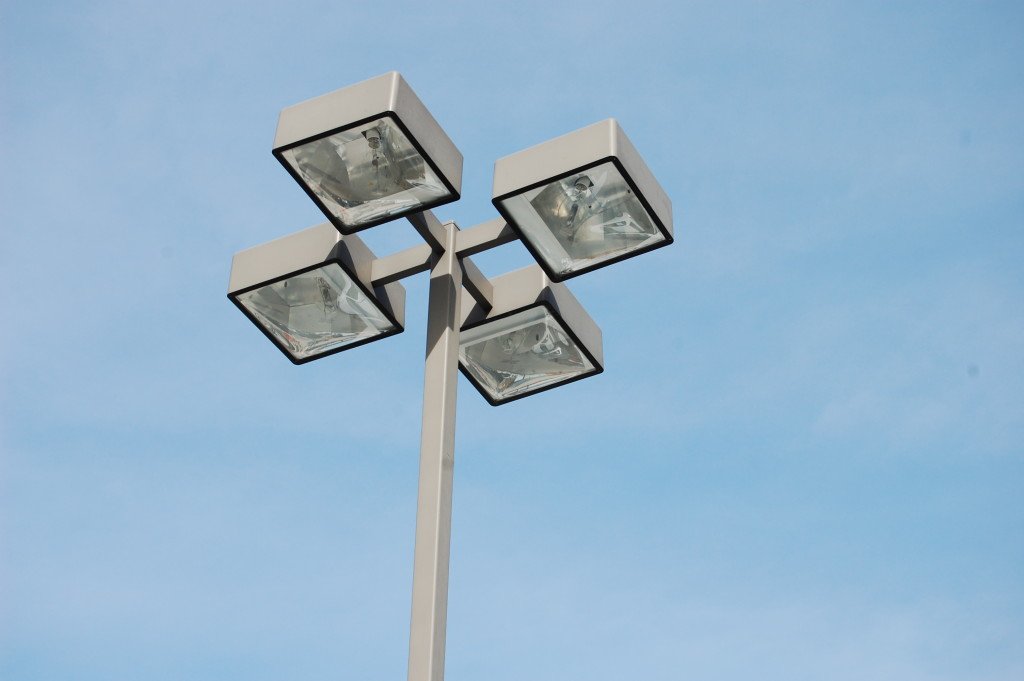
Light poles go in after the base is compacted, but their conduit goes in before it. That ordering is the heart of yard lighting and electrical site work: the pieces buried under the pavement have to be placed correctly the first time, because opening a finished truck court or lot to fix a missing sleeve is slow, expensive and disruptive to a plant in operation. We install the lighting, power and low-voltage infrastructure that serves the exterior of an industrial site, from the service entrance out to the gates, poles, cameras and equipment pads.
Exterior electrical work on a plant site is usually more than lighting. It includes power to gate operators, truck scales, dock equipment, fuel and fluid stations, charging for yard vehicles and, increasingly, conduit for electric vehicle chargers. Colorado's HB22-1362 requires any county or municipality that updates a building code on or after July 1, 2023 to adopt an energy code at least as stringent as the 2021 IECC and the state model electric and solar ready code, so new buildings and their sites are being designed with more electrification in mind.
We coordinate all of this with the electrical duct bank work that feeds the site and with the paving crews working on stabilized parking lots. A single schedule, shared by electrical and civil trades, is what keeps the work from being repeated.
Building the underground first
We begin with a plan that shows every pole, bollard, handhole, cabinet and equipment pad on the same drawing as the pavement design. Then we lay out conduit runs with enough spare capacity for future cameras, readers and power drops, because adding a conduit later means trenching through finished work. Handholes are sized for the cable bend radius, set at the right grade and rated for the vehicle loads they will see.
Concrete pole bases are formed and placed with anchor bolts set to the manufacturer's template, then checked before the pour. The bolt pattern, projection and plumb are small details that decide whether a pole stands straight for the next twenty years. We stage pole delivery with the paving schedule so the pole can be set when the base and cure allow, instead of waiting in a stack in the yard.
What we install on the exterior
Typical scope includes site lighting poles and fixtures, parking and truck court lighting, wall packs and dock lighting, conduit and wire, panelboards and transformers for exterior loads, and grounding and bonding. We also install the conduit and pull strings for gate operators, access control, cameras and communications, and coordinate with security integrators on equipment locations. Where the owner uses the yard at night, lighting levels, uniformity and glare control are specified and tested.
Electrical gear for process loads outside the building often arrives with its own pad requirements, which we build as part of the equipment pads and foundations scope. Heat trace, pump control power and instrument wiring for outdoor tanks and skids can also be included, depending on the project. We take the work to the point of energization and then support the owner through commissioning.
Codes, utility coordination and airport proximity
Fort Collins treats the 2024 International Building Code with local amendments as the current code for permits submitted on or after April 1, 2026, and keeps the 2021 codes available for reference until October 1, 2026. Electrical editions are set at the state level rather than by the city, so the National Electrical Code edition in force on your permit date is something we confirm for every job. The local utility has its own standards for service, metering and transformer pads, and the utility's schedule often controls when power can be available.
Lighting near an airport raises specific questions. Centerra Industrial in Loveland sits half a mile from I-25 and adjacent to Northern Colorado Regional Airport, so tall poles and certain fixtures there may need review for height and glare. We ask the jurisdiction and the airport whether such a review applies before we purchase poles, and we choose fixtures that control upward light and glare to keep the review short.
Dark sky, glare and nighttime safety
Exterior lighting rules differ by municipality, and the common goal is light that points down and stays on the site. We specify full cutoff fixtures with the right color temperature and aiming angle, and we check light levels at the property line when the design is complete. Good control keeps neighbors content and also helps pilots, drivers and workers who would otherwise face glare.
For safety, we insist on clear lockout procedures during energization and on documented testing of every circuit. Poles in truck courts carry crash protection where drivers could strike them, and we site them so that trailers' tails clear them in turning movements. Safety lighting at stairs, dock edges and crossings gets its own review because it is the lighting that prevents injuries.
Where we install exterior electrical work
Our exterior electrical work follows our industrial site work across the metro, from Fort Collins and Loveland to the plants of Windsor. The pattern changes with the setting: parks along I-25 favor tall poles and wide truck courts, while sites near a river or open space may require lower poles and shielded fixtures.
We also support owners in utilities and power where outdoor equipment yards, substations and control buildings need carefully laid out grounding and conduit. Whatever the setting, the same discipline applies: map the underground first, coordinate with the utility early, and test everything before the owner takes over.
Draw the underground before the pavement
Send us the civil plan and the electrical one-line and we will merge them into a coordinated underground layout. If your project also includes a larger site package, we can pair the work with the site utilities package to keep trenching to a minimum.
Common Questions
Should I put spare conduit under my new truck court?
Yes. Spare conduit is inexpensive when the trench is open and extremely expensive once the pavement is down. We usually recommend at least one spare power conduit and one spare low-voltage conduit along each major run, plus extra sleeves at gates and building corners.
How long does it take to get utility power to a new yard?
The utility's design, equipment lead time and construction schedule often set the date, and that can be longer than the site work. We bring the utility into the project during design, submit load information as early as possible, and set the transformer pad and conduit so the utility can connect as soon as its equipment arrives.
What lighting level do I need in a truck yard?
The right level depends on the activity: driving lanes need less light than loading zones or areas where people work on foot. We take the design from the owner's safety standards and the engineer's photometric plan, and we test the installed system against it. Over-lighting wastes energy and creates glare, so we aim to meet the requirement without exceeding it.
Can you install conduit for EV chargers now and add chargers later?
We can, and it is a sensible approach in light of state energy code direction. We install conduit, panel capacity and pad locations during site work, and the chargers themselves can be added later. That avoids cutting pavement and lets the owner phase the equipment as demand develops.
Who sets the pole base design?
The pole manufacturer or the electrical engineer provides it, based on the pole height, fixture weight, wind loads and soil conditions. We build to that design and check the anchor bolt template and reinforcement before we place concrete. If the soils at the pole location are poor, we flag it for the engineer.
Related
Related Services
Related Service Areas
Ready to talk about your project?
Request a Project ReviewOne project team for the whole sequence
Industrial Contractors of Fort Collins reviews the site, the loads, the schedule and the approvals before pricing, then schedules, coordinates and inspects the specialty trade partners from preconstruction through closeout.