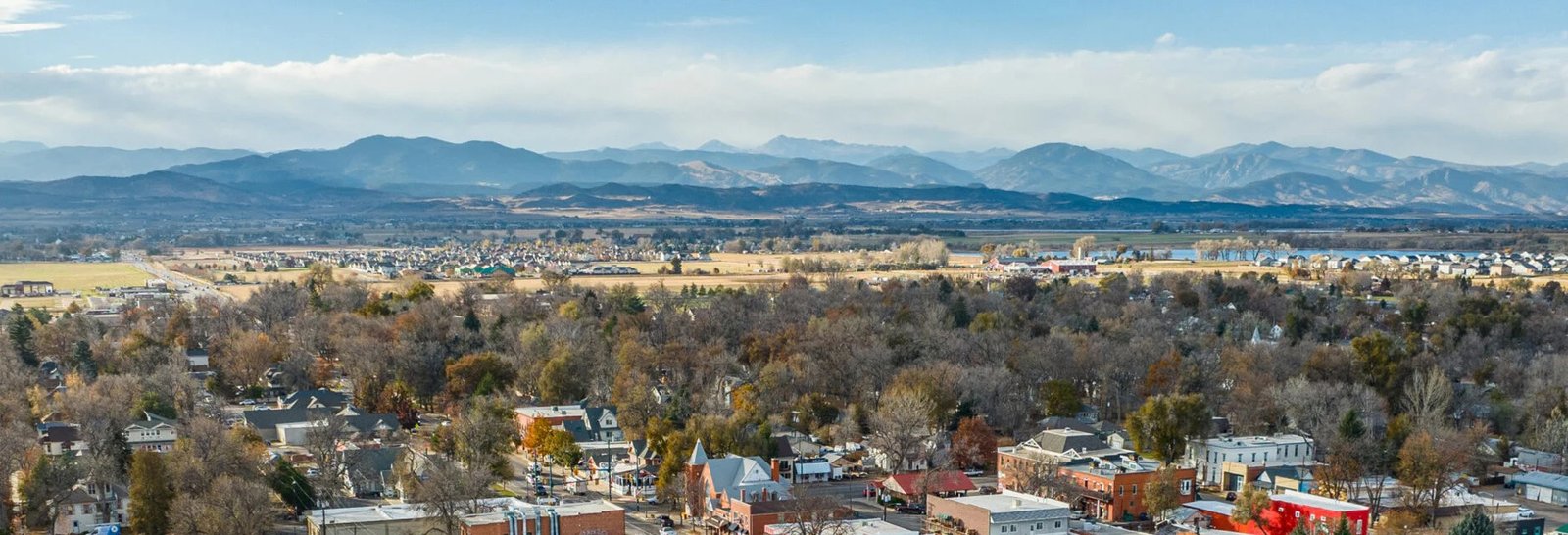
No interstate runs through Berthoud, and that shapes every industrial decision here. State Highway 56 runs 9.5 miles from US 287 in Berthoud east to I-25 exit 250 in Johnstown, so freight leaving a Berthoud site travels that road before it reaches the freeway. We design site entrances, pavement sections and haul routes with that single link in mind, and we build the shops, small plants and agricultural-support buildings that suit a town of this scale.
US 287 was rerouted in 2007 onto a bypass north and west of downtown Berthoud, moving through traffic off Mountain Avenue. For an owner siting a building near the bypass, that means highway access without sending trucks through the historic center. Berthoud is also growing, from 10,332 residents in 2020 to an estimated 14,080 in 2025, and growth brings both customers and congestion to a road network built for a smaller town.
A farm town becoming a commuter town
Berthoud sits at 5,033 ft elevation about 21 miles south of Fort Collins and 43 miles north of Denver. It covers 13.1 sq mi in Larimer and Weld counties north of the Little Thompson River, and its early economy was farming, including alfalfa, sugar beets and wheat. That farming heritage still shows in the work available: equipment storage, grain and feed handling, cold storage for produce and shops that serve the land around the town.
Its position between two larger markets creates a different kind of demand. Trades that serve houses in both directions want a base with a shop, a yard and quick access to the highway. Owners that supply food and beverage operations farther up the corridor look for space to aggregate, pack or store product close to the farm, and a modest building on the right parcel can meet that need without the cost of an urban site.
Shops, packing halls and small production buildings
Projects at Berthoud's scale tend to run from a few thousand to a few tens of thousands of square feet. One might be a vehicle and equipment shop, a packing and cold-holding building, or a small production space for a specialty maker. We build such work through light manufacturing and flex industrial scopes, which pair an economical shell with the utilities the use requires: three-phase power, floor drains, compressed air rough-in and ventilation.
Many owners here prefer a pre-engineered metal building because it goes up quickly and costs less per square foot than other structures at this size. We assess the structure against snow, wind and use before recommending it, and we detail the slab, wall insulation and door openings to suit the occupant rather than leaving them as afterthoughts.
Small-town review, utilities and long-lead orders
A smaller jurisdiction usually means a smaller review staff, and that can be good or bad for the schedule. Staff know the town, but a complete submittal with clear drawings matters even more, since a returned set may wait a long time for the next review slot. We assemble the submittal with a checklist, confirm the town's requirements by phone, and track comments until the permit is issued.
Utility service is the other variable. Electric capacity, water and sewer availability, and fire flow can determine whether a parcel works for a given use. We ask the providers for will-serve letters and cost estimates early, and we use long-lead procurement management to order transformers, switchgear and rooftop units as soon as the design is stable.
Trenches, ditches and a working highway
Land north of the Little Thompson River and the farmland around town is crossed by irrigation ditches, buried lines and old field drains. Before we dig, we locate utilities, identify ditch rights and check the mapped drainage, and we protect any channel that stays in service. Trench safety is part of every utility day: sloping or shoring, a competent person on site, and a clear way out of each excavation.
The power service for a new building often needs its own trench, and our experience with underground electrical duct banks keeps conduit depth, separation and concrete encasement consistent with the utility's standards. Work along Highway 56 or the US 287 bypass requires traffic control plans and approved access, so we schedule those tasks around the permit and keep flaggers and signage in place whenever equipment crosses a public road.
Between Highway 56 and the Front Range towns
From Berthoud we serve the stretch that runs east on Highway 56 to Johnstown and the I-25 interchange, and north toward Loveland and Fort Collins. The towns are close enough that one crew can work on projects in two of them without long remobilization, and that keeps small projects economical.
For projects that need materials delivered, we plan the route from the supplier through the interstate and Highway 56, because the final miles often decide the delivery time. When a project is small enough to be managed by one superintendent, owners get a single point of contact from permit to final inspection.
Share the use and the location
Tell us what the building will do, how big it needs to be and where you are looking. We will check access and utilities and send back a clear plan.
Common Questions
How does the lack of an interstate in town affect a trucking-dependent business?
Trucks have to use State Highway 56 or US 287 to reach the freeway, and that adds travel time compared with a site next to an interchange. For many businesses the effect is modest, and the lower land cost offsets it. We map the likely truck routes and test the entrance design against the vehicles you expect before you buy or build.
Is a pre-engineered metal building a good choice for a Berthoud shop?
Often. It is quick to erect, economical at modest sizes, and easy to extend later. The details that matter are the foundation, the insulation and the door sizing, and we work those out with the manufacturer. If your use needs heavy cranes or unusual spans, we will tell you where a conventional structure may serve better.
How do we confirm utility capacity before buying a parcel?
Ask the electric, water and sewer providers for written statements of availability and for the cost of connecting to your parcel. We can prepare the load information they need, including expected power demand and fire flow. A parcel that looks cheap can turn out expensive if the nearest transformer or main is far away.
Can you build on land near an irrigation ditch?
Yes, with attention to the ditch owner's rights, setbacks and drainage. Ditches may carry water seasonally and may have access easements that limit what can be built nearby. We confirm easements through the title work, lay out the building to respect them, and design drainage so stormwater does not flow into a ditch without approval.
What permits should we expect for a small plant?
Expect a building permit, a site plan or development review, utility connection permits and, for work near highways, an access permit. Some uses also need fire department review for storage or process hazards. We list each approval and its likely lead time at the start so the schedule reflects the longest path.
Related
Related Services
Related Building Types
Related Service Areas
Ready to talk about your project?
Request a Project ReviewOne project team for the whole sequence
Industrial Contractors of Fort Collins reviews the site, the loads, the schedule and the approvals before pricing, then schedules, coordinates and inspects the specialty trade partners from preconstruction through closeout.